No. The 6m Battery is EOL. That is why the Universal Shift Battery was made back compatible with the 6m. The new battery technology was adapted to old designs. Suggesting do fit the 6m Battery into the new devices is suggesting to adapt an old technology, which isn't produced any more, for new devices. The usecase would be limited to users who have 6m batteries, which they don't use in an 6m and which are still good (after 8 years), and have a 6mq or 8. It's unlikely that you'll find a significant number of such users.
- About Capacity:Actually, In fact, the 6M's battery capacity is superior (6M's4242mah; 8.1 3820mah)
- about SIZE:The size of the 6m battery can carry a larger capacity than the 8
- About Sustainability: Even though the old devices are EOL, their components (including batteries) are still in good condition. Yet, they are incompatible with new devices. This seems to contradict the principles of sustainability and reducing e-waste for my view.
- Customers who purchased the 6m battery in its later stages still have cells in a very healthy condition. Speaking from my personal experience, SHIFT's battery cells are of exceptional quality; whether for the 5me or the 6m, there has been no swelling or rapid degradation even after 7 years of use. Furthermore, SHIFT's batteries can support any type of external charger available on the market, whether in Asia or Europe. In contrast, Fairphone's batteries are incompatible with external chargers (at least, compatible chargers cannot be bought in Taiwan). Meanwhile, the batteries for the Fairphone 3 or the Samsung S5 usually swelled up after just about 1 to 2 years.Therefore, even if a battery has reached EOL, wouldn't it be much better if users with old batteries could still use them in new devices, provided that the new devices are designed with backward compatibility in mind?
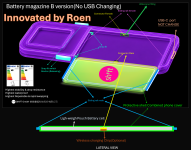
No. The current battery consists of a tiny pcb with cell protection,
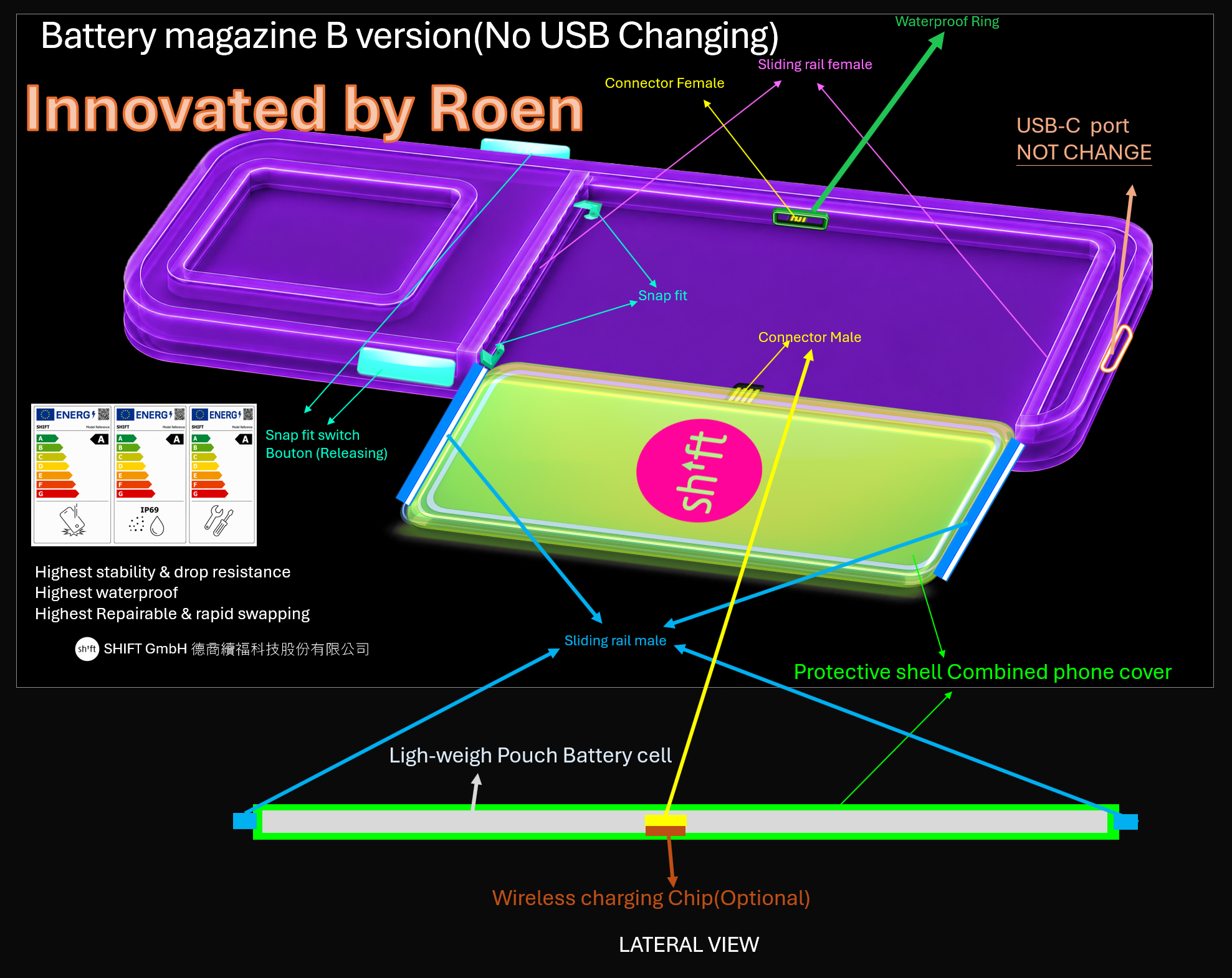
tiny pcb with cell protection(Current battery)→tiny pcb with cell protection(Battery Magazine)
the battery pouch and minimal "casing".
Battery pouch(Current battery)→Battery pouch(Battery Magazine)
Minimal Casing(Current battery)→Protective shell(Battery Magazine)
Is the minimal 'casing' of traditional batteries the main factor limiting the development of larger capacities,
or not? And
is it also why modern smartphone batteries have eliminated the outer housing, shifting toward pouch cells to maximize battery capacity
right?
Very easy to recycle with. You are adding a lot of hardware to this very simple swappable battery, which increases waste either way.
- In reality, I only added slides rails, snap-fits, and release buttons and connector .
- And the outer shell of my battery magazine is itself the phone’s back cover, completely replacing the original back cover of the phone.
You neglect, that you are also adding a charging pcb and usb connector. These increase the amount of electronic waste when swapping the battery and the additional casin makes the recycling process more difficult and adds additional waste.
Sorry Let me emphasize again: I only
movedthe battery magazine of certain models, I did not
replicate them.
1.You say, the casing is insignificant, but even 1g additional casing weight in each currently sold smartphone will increase plastic waste by over a 1000 metric tons every year (global smartphone sales in 2023 was 1300.000.000 units).
- This premise is defined under a non-sustainable phone that cannot be upgraded, lacks forward or backward compatibility, and is impossible to repair or swap parts for under which, this is possible.
- Compared to PCBs, chips, batteries, and other electronic components, pure plastic structural parts are generally not considered the primary source of toxicity in electronic waste. Unless they are illegally burned or exposed to high temperature decomposition, their environmental risk is usually lower in comparison.In addition, AI intelligent recycling technologies are continuously improving and may become even more advanced in the future through intelligent recycling systems.My battery magazine shell is designed as a long-term reusable mechanical structural component
- Please compare my battery magazine (protective shell + latch + slide rails + button) VS (an external power bank + external charger + plastic battery protective box + back cover): which one actually uses more plastic?
- My waterproof ring only needs a very short section to seal off the connector poles. Compared to the existing design that wraps around the entire perimeter of the battery, which one uses more plastic and results in a heavier weight?
- Frequent plugging and unplugging of traditional USB ports causes wear and tear over time, increasing the failure rate. When a traditional USB port breaks, you often have to replace the entire motherboard. In contrast, with my battery magazine, you only need to replace the USB port itself, without touching the motherboard.
- You might have overlooked one point: my battery magazine is designed to be openable, meaning the battery cell, charging IC, USB port, and connectors can all be opened and replaced
- And the outer shell of my battery magazine is itself the phone’s back cover, completely replacing the original back cover of the phone.
- Your concept can be retrofitted to at least one of the Shiftphones currently using the the universal battery.
- For 6m or 8 :By swapping the Shift skin (frame module), it can be compatible with motherboards and cameras from both the SHIFT 8 and SHIFT 6m.
- For 5me: However, because the 5me is smaller in size, it will likely require an additionally customized frame to fit
Financial viability of either maintaining two systems or replacing the old one.
Step by step
Technicall viability of your design independent of device.
For Detal :Next step by step
Your concept is in fact future proof.
Human Factors Engineering (HFE) and
User Experience (UX):Please compare these two workflows:
Workflow 1:Press the release button → Eject the battery magazine → Plug in the USB cable to charge the magazine→Reinsert the battery magazine into the phone..
Workflow 2:open the back cover → Remove the battery with your fingernail → Pick up the external charger → Connect the battery to the external charger → Plug the USB cable into the external charger → Unplug the battery from the external charger → Line up the battery and pop it back into the phone slot→Snap the back cover back on.
- Which one is faster? Which one is more convenient?
- This is especially critical for the elderly, individuals with disabilities, and in emergency situations.
- Is Workflow 2 indeed the primary reason why battery swapping lost the competition to power banks among today's mainstream consumers, or not?
Good recycling strategy of your new battery concept.
1. We can reference Dyson's recycling model, because Dyson's batteries also contain a charging IC and do not require an adiitional external charger.
2. Since the battery magazine I designed can be opened and disassembled, old USB ports, connectors, or cables, etc., can be reused. We only need to recycle the protector shell and the pouch cell (because letting users remove the cell themselves will cause safety issues, and transporting the cell alone also has safety issues). The recycling technology and channels can be executed by distributors, recyclers, or repair shops authorized by SHIFTor by mailing it back to SHIFT's repair orrecycling department (for Asian or European customers) .
Market analysis of users prefering the new concept instead of the old.
- If future batteries are eventually able to provide enough capacity to support one or even two full days of heavy all-day work usage, the demand for fast-swappable batteries may decrease. But what if current battery technology still cannot fully achieve that today?
- Even if the first point eventually becomes achievable, battery capacity still degrades year after year over time. Under heavy all day work usage, maintaining reliable battery life beyond a full day may still become difficult. Because of this, the demand for fast-swappable batteries may never fully disappear.
NoMoPhobia Low-battery Anxiety Consumer Study

counterpointresearch.com
Indeed. That is what I was arguing the entire time, which will improve the capacity of the current universal battery. What makes your concept different?
About my battery magazine:
- More Capacity : There is no need for even a minimal casing to wrap around the battery cells, so their shape and size and flexibility are not restricted.
- Lighter Weight :Without a minimal casing and back cover, the overall weight is reduced.
- Future Compatibility: Without the limitations of a minimal casing, future battery materials such as silicon-carbon, solid-state, and others can be accommodated and upgraded.
- safety: In hazardous situations (such as a lithium battery fire), the battery can be quickly ejected without touching the battery cells or the battery pack.
The included bumper already does a great job. Improve the mechanism of the back cover and it should suffice. Is the current bumper compatible with your battery magazine or will this add another cost and waste point?
YES, compatible with my battery magazine
The current battery is perfectly swappable. If it increases in capacity due to new battery technology, it will be easily implementable into legacy shiftphones without major modifications like changing the frame, antennas and sub pcb.
My battery magazine also is,but only need to swap frame
Shift is working on such a product.
I know; my battery magazine simply integrates this product, adds sliding rails and fixing structures, and simplifies the operating process.
Enhanced rear cover design in future model should help with that.
I fully support this
Shift still has a long way to go before expanding significantly into the asian market.
It is not difficult because SHIFT's production base is in Asia. Shipping internationally via modules in the future can save a lot on taxes; however, the main priority remains establishing recycling stations and technical support hubs.
The current universal battery maintains them perfectly.Shift worked hard for having a universal battery and now you want to throw it away?
- Do I look like I'm about to throw away SHIFT's current universal battery? For my future plans, I am mostly keeping SHIFT's current battery size and shape. https://forum.shiftphones.com/attachments/1778545127877-jpg.7198/
- Does that mean I should halt my research on improving the cell materials and battery capacity for SHIFT's current universal battery?
- I am not trying to throw away the universal battery. On the contrary, many of my ideas are actually extensions built upon it. The current universal battery is indeed one of SHIFT’s most important and unique achievements, and I fully recognize its value in repairability, compatibility, spare part management, and sustainability.
However, I do not believe that continuing the universal battery philosophy and exploring new structural possibilities are necessarily contradictory. The core concept I am currently proposing mainly adds rails, locking latches, release buttons, and a protective shell evolved from the original battery casing and smartphone back cover, rather than completely replacing the entire battery platform.In some ways, my direction is actually intended to extend the lifespan and battery capacity of the entire battery ecosystem, improve cross-device compatibility, create more external usage scenarios, and reduce user dependence on power banks and other duplicated accessories
- You may perhaps understand the concept of product diversification and market segmentation. Different users, different usage scenarios, and different working and living environments may naturally lead to different product needs. A single product may not necessarily be suitable for every market or every user.
In fact, SHIFT itself previously had products with different positioning at the same time, such as the SHIFT5me and SHIFT6m. This does not mean that the existence of the SHIFT6m was intended to replace or deny the SHIFT5me, but rather that different users may naturally have different needs regarding size, weight, portability, battery capacity, and usage scenarios.
For example, personally, under normal daily situations I may prefer to carry the 6m; however, during sports, travel, or situations where lighter portability is more important, I may choose the 5me instead. The two are not necessarily in conflict, but rather complement each other.
Therefore, I believe that exploring different forms of battery structures does not necessarily mean rejecting or replacing the current universal battery, but may simply provide another option and possibility for different usage scenarios.
Furthermore, I believe that maintaining a certain degree of product and technological diversity can also improve SHIFT’s resilience against future uncertainties. For example, if future EU requirements regarding drop resistance, waterproofing, or battery regulations become stricter, or if supply chains, market demands, or component availability change unexpectedly, at least SHIFT would not be completely restricted to a single design direction.
- For general users, the current universal battery may already be sufficient, and I do not believe that everyone necessarily needs a design such as the battery magazine.
However, for certain specific usage scenarios, such as users who require longer battery life, long hours of outdoor work, higher mobility demands, or higher levels of drop resistance and waterproof protection, this type of product may still have value.
For example, some outdoor workers, travelers, heavy smartphone users, elderly users, or some users with limited mobility may place greater importance on faster energy replacement, easier-to-operate structures, additional protection, and longer continuous usage capability.
Therefore, I believe this kind of concept is not necessarily intended to replace the universal battery, but may simply provide another option for specific usage needs.
and now you want to throw it away? You previously argued for inter-device compatibility and now you ar arguing against it? How can you be so inconsistent?
You misunderstood my point. From the very beginning, I have consistently supported a compatibility-focused design philosophy, and not only vertical cross-generation compatibility, but also horizontal cross-device compatibility.
Therefore, my idea was never to abandon the universal battery or argue against inter-device compatibility. On the contrary, I want to further explore additional possibilities for different usage scenarios while keeping compatibility as the foundation.
So I do not believe there is any contradiction here. In fact, many of my concepts are built around the core idea of extending compatibility and maximizing the lifespan of the overall platform ecosystem as much as possible.
3D printing is only viable for very small production runs. For high volume production runs 3D printing increases costs significantly. Which is why shift uses injection molding, which is the current industrial gold standard. You are also adding a complex usb-c connector, data cabling, and charging electronics. Currently the replacement battery costs less than 3% of the devices price when new. Your concept will increase this by a factor of 2 or 3. Currently the battery is a standard battery which can be produced at every battery manufacturing plant. Your concept requires the addition of a non-standart case, custom charging electronics, and a custom connector. This will most likely require an additional manufacturing and assembly step.
- I never suggested relying entirely on 3D printing for future mass production.the 3D printing and Industry 4.0/5.0 because they mitigate prototyping costs, low-volume customization costs, initial trial production risks, and experimental barriers for modular products.Even today, standard industry practice runs parallel: injection molding handles mass production, while 3D printing handles prototypes, small-batch modules, and custom parts.The two are complementary, not mutually exclusive.
- The core concept I am currently proposing mainly adds mechanical structures, such as rails, locking latches, release buttons, and a protective shell evolved from the original battery casing and smartphone back cover.
This is even more insane!
- What I mean by “limited production” is not artificial scarcity or abandoning sustainability. It is closer to a controlled experimental rollout. For a relatively small company like SHIFT, immediately mass-producing a completely new structure at large scale could instead create risks such as quality control problems, excessive spare part pressure, repair system instability, inventory waste, and even higher sustainability risks.
- Therefore, starting with a smaller rollout to evaluate structural reliability, user acceptance, repair capability, and long-term spare part support may actually be more consistent with the risk management logic of a sustainability-focused company.
- Short-term tactics focus on controlling risks and testing viability. Medium-term strategy focuses on gradually stabilizing the supply chain and ecosystem. Long-term goals focus on building a truly sustainable, repairable, and long-term supportable product system.
- And because SHIFT already values long-term repairability and spare part support, even an initially limited rollout could still provide long-term spare parts and repair support for those users, rather than becoming a disposable or abandoned product
Let me give an example:
Some companies’ software products are only available for purchase within 3 months, or limited to 100 copies. However, the company still provides later updates, services, and support for the people who bought those products.
So, does this model violate any sustainability principles?
Because our SHIFT has a deposit system, it is relatively easier for us to identify the users.
The current battery is great because it's universal. It supports current and legacy devices,
The included bumper already does a great job. Improve the mechanism of the back cover and it should suffice
The current battery is perfectly swappable. If it increases in capacity, due to new battery technology, it will be easily implementable into legacy shiftphones without major modifications like changing the frame, antennas and sub pcb.
I fully support this point; this is exactly the primary reason I have been promoting it in Asia.
Especially the fact that the current battery can be replaced
without requiring any tools is the best part.
so everytime you order a new battery, you'll get a brand new one. If you have device specific batteries, you'll get new-old stock, which has been on a shelf for years and has thus deminished in quality.
- Solid state battery:That concern may be less significant in the future if solid state batteries become mainstream, since they are expected to have much better storage stability and slower calendar aging than today's lithium ion batteries.
- This also involves issues related to EU 2023/1670, the Battery Passport, and long-term supply chain management.
Battery aging and inventory turnover are challenges that all lithium battery platforms must face, not only device-specific batteries.
My Battery Magazine concept is not intended to make every device depend on completely different and non-replaceable battery cells. Instead, I hope it could move toward a
replaceable and compatible cell-family approach, allowing the cells inside the battery magazine itself to be replaceable.
In the future, this concept could potentially explore directions such as:
universal or semi-universal cell platforms, replaceable compatible cell families, high-turnover supply chains, universal BMS platforms, and cross-generation compatibility designs. Combined with strategies such as partial pre-order production, rolling replenishment, or limited-batch manufacturing, these approaches may help reduce old stock, long-term inventory aging, and future spare-part supply pressure.
Of course, there would still be many detailed challenges and problems to solve. I simply believe these may be some possible directions for future solutions.
Your argument is based on the assumption of large scale production combined with long term stockpiling over many years.However, if part of the production instead adopts small batch production, the situation could become very different.Battery technology, energy density, safety, and manufacturing processes are continuously evolving. Small batch production may actually allow later batches to gradually adopt newer battery cells or improved chemical technologies, rather than depending on years old battery cells stored for long periods of time.Therefore, I do not think the “old stock battery cell” problem is necessarily impossible to solve.As battery technology continues to advance, battery cells produced in later batches may potentially have better quality and even higher mAh capacity.Furthermore, with the future development of smart factories, Industry 4.0/5.0, flexible manufacturing, and customized production technologies, this type of small batch production model may also gradually become more mature.However, this still requires further research, because it would also involve EU 1670 related long term spare parts supply requirements, as well as the requirement to deliver spare parts within 5 to 10 working days. Therefore, inventory management and supply chain management issues would also need to be considered.
2.Would it also be possible to share the same or compatible cell family, or at least the same battery chemistry platform, with the existing SHIFT 8 battery?
If both systems could share part of the same cell supply chain and platform, then when demand for the existing SHIFT 8 battery is higher, the supply chain could prioritize supplying cells to the original battery platform. Conversely, if demand for the Battery Magazine becomes higher, it could also share part of the existing cell supply resources.
I believe this kind of platformization and shared supply-chain approach may improve turnover rates and supply flexibility, while also reducing old stock, long-term inventory aging, and future spare-part supply pressure.
As said before: I think you don't value sustainability,
If I had designed the battery magazine to be permanently soldered into the phone, or designed the battery to be locked in place with screws so that users would need tools to replace it, then criticizing my idea as being unsustainable would be reasonable. But my design is the opposite.
Since Project Ara was cancelled in 2016, I have never bought a non-sustainable smartphone again. What do you think?
If I don't value sustainability, I would not have spent the last decade continuously researching topics such as compatibility, modular reuse and recycle, legacy support, modular upgradability,
https://forum.shiftphones.com/attachments/1778545479205-jpg.7203/ and portable operating systems like Win2USB.
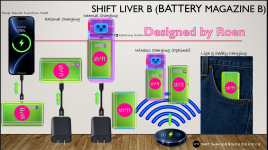
A. A SKIN compatible with 8.1 or 6M / 6MQ BATTERY
B. B SKIN compatible with BATTERY MAGAZINE A (without charging IC, external charging not supported)
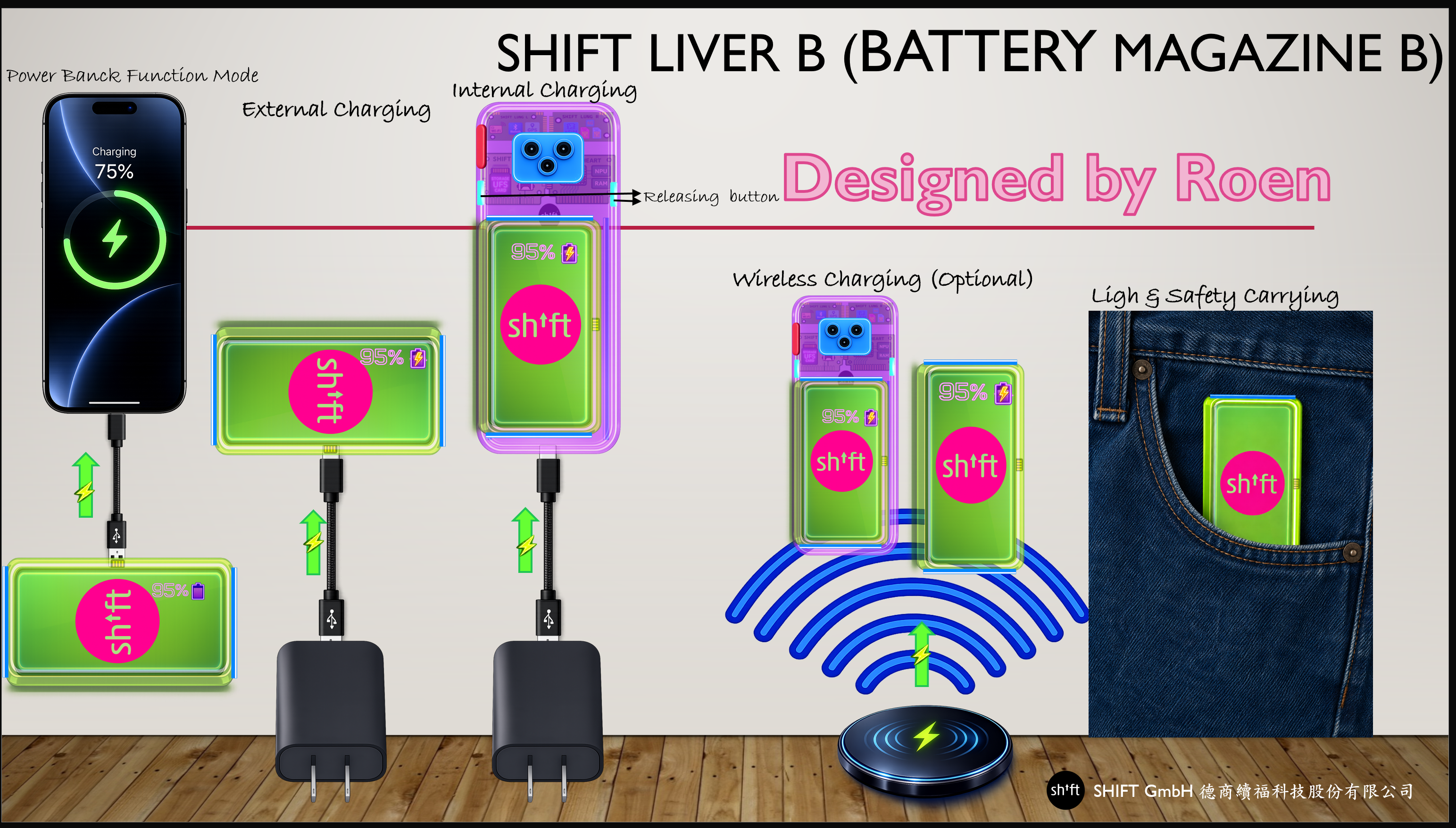
C. B SKIN compatible with BATTERY MAGAZINE B (with charging IC, external charging supported)
D. B SKIN compatible with BATTERY MAGAZINE C (with charging IC and wireless charging)
E. B SKIN compatible with BATTERY MAGAZINE D (with charging IC, wireless charging, and solar charging)
Sorry, I need to emphasize this once again.:A, B, C, D, E are all mutually compatible with each other. Using one would not make the others become waste.
As already discussed above.
Let’s talk about user opinions, especially regarding speed and convenience.
Scenario A: Charging Environment
Workflow 1 — Battery Magazine
Press the release button → Eject the battery magazine → Plug the USB cable directly into the battery magazine for charging → Reinsert the battery magazine into the phone.
Workflow 2 — Traditional Removable Battery
Open the back cover → Remove the battery with your fingernail → Pick up the external charger → Insert the battery into the external charger → Plug the USB cable into the external charger → Remove the battery from the charger → Align the battery and place it back into the phone → Snap the back cover back on.
Scenario B: Carrying Spare Batteries in a Pocket
Workflow 1 — Battery Magazine
Press the release button → Eject the battery magazine → Take a charged battery magazine from your pocket → Put the empty battery magazine into your pocket → Reinsert the battery magazine into the phone.
Workflow 2 — Traditional Removable Battery
Open the back cover → Remove the battery with your fingernail → Take the plastic battery case out of your pocket → Open the plastic battery protector box → take the spare battery while still holding the depleted battery → Put the depleted battery into the plastic battery box → Close the plastic battery box and place it back into your pocket → Align the battery and place it back into the phone → Snap the back cover back on.
From a human factors engineering and UX perspective, which workflow would be faster and more convenient for users?
or SHIFT as a company. You just want to sell your "the smartphone battery is like a pistol magazine" idea..
Sell Idea?
I feel your imagination may be a bit too excessive.
Honestly, if you had not said that, I probably would not even have thought about it that way.
I'm not a factory, I'm not a supplier..........., so why exactly am I supposed to sell it?
Except for the SHIFT Asia staff, I was the first SHIFT5me user in Asia, the first SHIFT6m user in Asia, and now I am also the first SHIFTphone 8.1 user in Asia.
Personally, I do not care that much whether my battery magazine idea can actually be realized. What I truly care about is whether SHIFT can survive and continue to exist in the future.
Moreover, the SHIFT LIVER battery concepts I currently have are not limited to only one design. The Battery Magazine is just one of more than ten different concepts I currently have in mind.
One of the reasons why I posted this concept publicly is to help SHIFT establish prior art first, in order to prevent another company patenting similar ideas earlier in the future.
What you are suggesting will destroy the soul of SHIFT
I believe no one on this forum truly wants to destroy the soul of SHIFT.
Okay, let’s talk about the soul of SHIFT.
Beyond the 13R principles, SHIFT also value "minimalism" and simplicity in its design philosophy.
https://www.shiftphones.co.nz/
May I ask you:
Should we pursue structural simplicity at the cost of operational complexity for the user; or slightly more structural complexity that creates greater operational simplicity for the user?
By now, I don't think you are being completely honest, when you write that. See the red texts above.
Please try to think from SHIFT’s perspective:
Since the Fairphone 6 no longer has a true instant-swappable battery design, some users who still value instant battery swapping may gradually shift toward SHIFT. The ability to instantly swap batteries and maintain uninterrupted relay-style power usage could potentially become one of SHIFT’s strongest advantages in the future.
So I think there are several important strategic questions worth considering:
- Currently, what percentage of our customer base (customers who have purchased our SHIFT products) mainly chooses SHIFT because of sustainability or environmental values?
- Currently, what percentage of our customer base is loyal specifically to the SHIFT brand itself?
- Currently, what percentage of our customer base chooses SHIFT mainly because of repairability and easy maintenance?
- Currently, what percentage of our customer base chooses SHIFT mainly because of true instant battery swapping?
- Currently, what percentage of our customer base chooses SHIFT mainly because of the availability of de-Googled Android versions?
- If within the next 1–2 years, other smartphone brands reach battery capacities of 10,000–15,000mAh together with significantly faster charging technologies, while SHIFT batteries only improve to around 4,000–5,000mAh, meaning one battery from competitors could equal two or even three SHIFT batteries, Under such circumstances, what percentage of users might potentially change their purchasing preference regarding SHIFT products?
- With the rapid development of AI, software development(like AI coding...) may become increasingly accessible to ordinary users. If software becomes more open in the future, will hardware become more open as well, or more closed?
- If future EU regulations such as EU 1670, 1542, or similar regulations eventually force mainstream smartphone brands to become significantly easier to repair (for example, restricting excessive glue usage and requiring user-friendly repairability), what percentage of SHIFT’s current customer base could still remain loyal to SHIFT?
Smartphones with fast swappable modules have been a niche on the market, so I don't think that it's the right way to attract more users. .....with no BS however is a good way to attract consumers.
1.“Niche market” does not mean that it is impossible to attract more users from the mainstream market(In my View).
Many successful products and brands originally began by focusing on small but core niche demands.
If, in the future, repairability and sustainability gradually become basic requirements that the entire industry in the EU must follow, should we also begin thinking about add new directions for future uniqueness and differentiation?
2.Fast swappable modular designs can actually be very meaningful and important for sustainability.
First, if the modules themselves are
upgradable, users may be able to upgrade specific modules instead of replacing the entire device every few years, thereby extending the overall lifespan of the device.
Second, some modules may potentially
support sharing, reuse, or rental across multiple users or devices in the future, which could help reduce resource waste and unnecessary repeated purchases.
Third, when certain hardware modules develop design
flaws, failures, or other issues, only the affected modules would need to be
recalled and replaced, rather than requiring users to wait for an entirely new generation of devices before replacing the whole product.
3.For consumers, fast swappable modular designs may allow specific modules to be upgraded without needing to purchase an entirely new smartphone, or even shared and reused between different users. This may provide greater value in terms of consumer benefits, economic efficiency, and resource efficiency.
A reasonably priced good product
I believe this is reasonable from a user pays perspective.
For certain special products or projects, it is reasonable for consumers to help share part of the research, development, and production costs, while also allowing SHIFT to retain part of the revenue for profit and future growth.
In addition, I believe that most consumers would also be willing to pay a higher price for such products.